
reality check: what’s your problem
OVERVIEW
Your organization might need a Reality Check.
Before the numbers, customers, or competition deliver it for you.
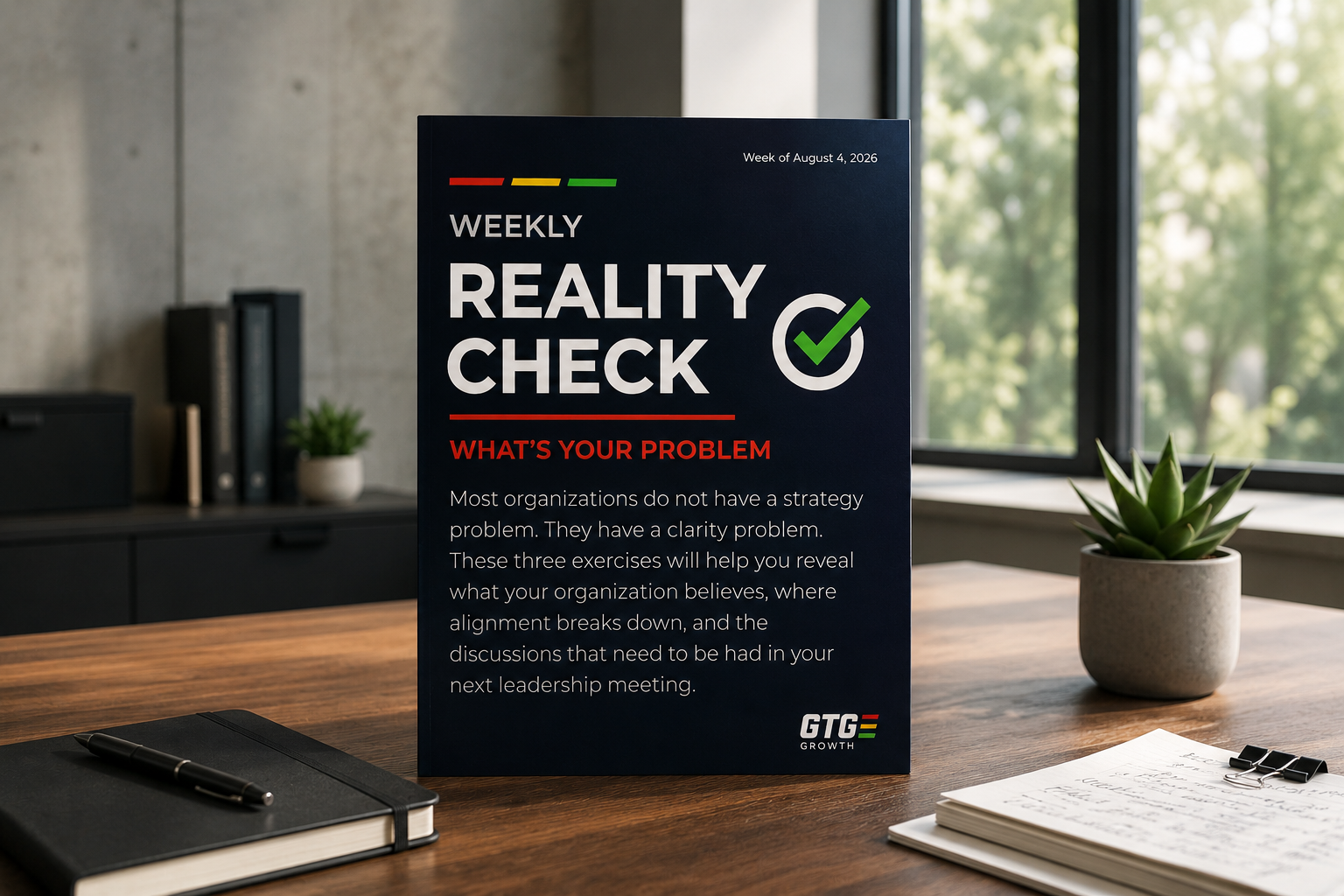
The GTG Reality Check is a practical executive action guide designed to help leaders know what is really happening inside their organization, fix what is getting in the way, and grow with greater clarity.
This week’s edition starts with one deceptively simple question:
What customer problem has your organization chosen to own?
Not every problem. Not the vague one on the website. The one your entire organization should understand, align around, and know how they contribute to solving.
Through three simple actions, this guide helps leadership teams uncover what people believe, where the answers differ, and what conversations need to happen next.
No giant deck. No complicated system. Just a practical starting point for getting everyone focused on the same customer, the same problem, and the same promise.
INSIDE THIS GUIDE
This guide includes three simple actions designed to help your team move from assumptions to a clearer shared understanding.
You will:
Ask a cross-section of your organization to define the customer problem you solve
Complete a set of Leadership Mad Libs independently
Compare the answers to uncover alignment, inconsistencies, and missing perspectives
For B2B organizations, the guide helps you explore the customer’s Performance, Professional, and Personal needs.
For B2C organizations, it helps you consider the customer’s Heart, Mind, and Wallet.
Together, these exercises reveal whether your organization understands the same customer, the same problem, and the same promise.
start the conversation
Every GTG Guide is designed to spark conversations that create greater clarity, stronger alignment, and meaningful action. The goal is not to convince you to agree. It’s to inspire conversations that challenge assumptions, sharpen thinking, and create meaningful change.
Use this guide to help facilitate a meaningful conversation with your leadership team using the answers generated through the exercises inside.
Compare what people believe, identify where perspectives align or differ, and pay close attention to what may be missing. Use the conversation to identify the customer problem your organization is best positioned to own, what falls outside that focus, and how every team contributes to solving it.
Do not start by polishing the language.
Start with clarity.